


Quarter Mile Calculator
Select the equation, parameters to be determined, and provide the required ones. The calculator will try to calculate the elapsed time and trap speed of the car.
Quarter Mile Calculation:
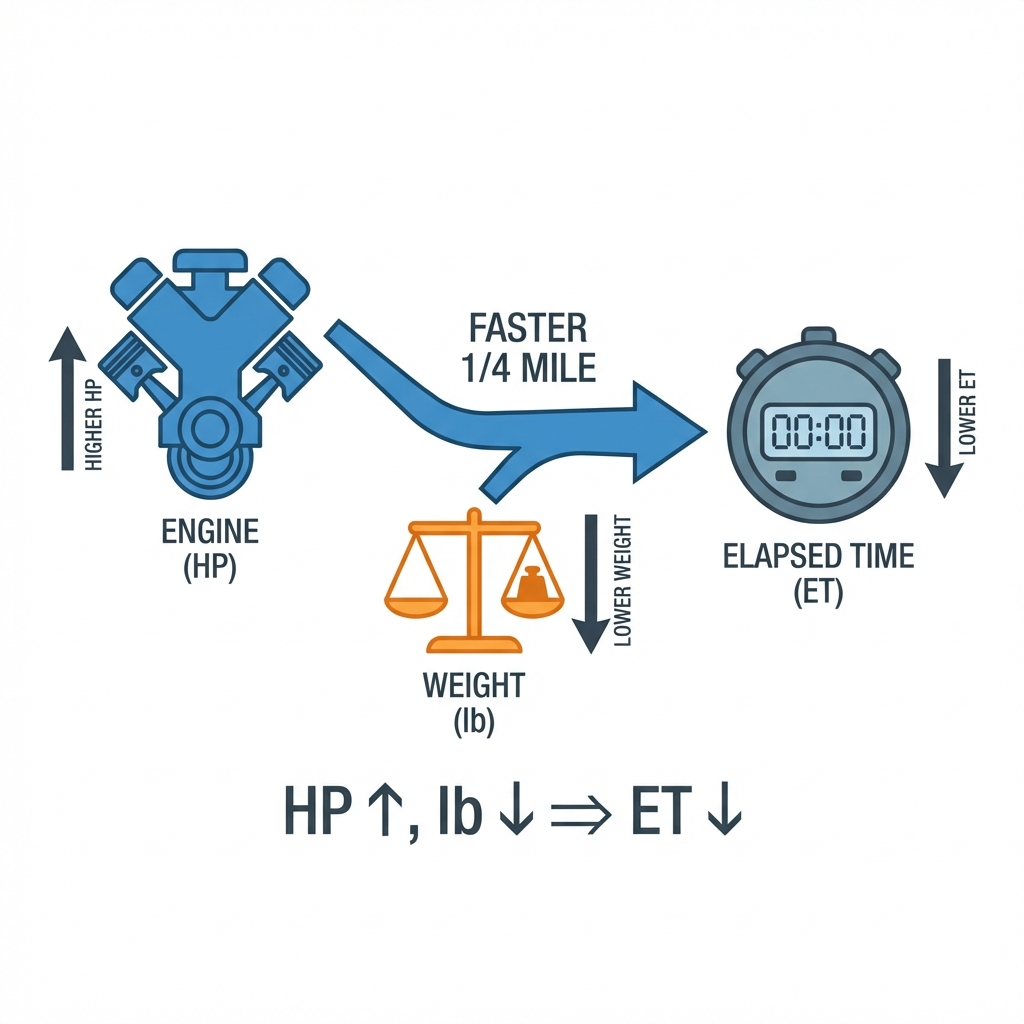
The main question here is, what is the quarter miles calculation and why do we need to find the quarter mile calculation. When we are finding the quarter mile of the car, then it is essential to find elapsed time and the trap speed(mph). These calculations are based on the flywheel horsepower and the weight of the vehicles. We are using the car power and weight to find its 1/4-mile elapsed time (ET) and the final speed(trap speed). We can measure the elapsed time and the trap speed by the quarter mile calculator: You can set the target time for your race.
- Learn how the power upgradation of your engine affects ET(Elapsed Time)
- Find how reducing the car weight affects the performance
We need to find some of the following terms to understand the quarter mile calculation:
Elapsed Time:
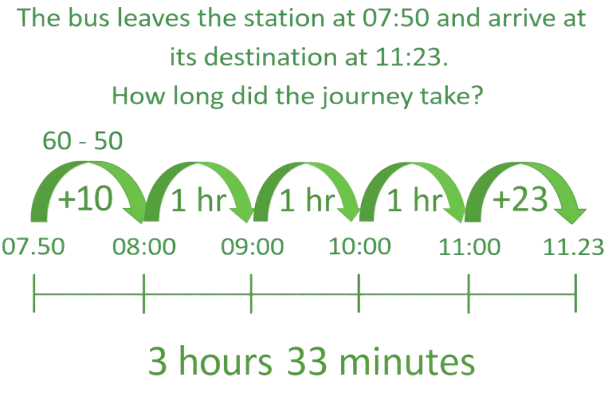
“Elapsed time is the amount of time required from the start of an event to the end of an event.” The simple formula for calculating the elapsed time is:
\[ \text{Elapsed time} = \text{End time} - \text{Start time} \]
Example!
What is the elapsed time of the car if it starts its journey from 9:00 a.m. to 12:00 p.m. and then again, it starts its journey from 12:00 p.m. to 7:30 p.m.
Solution:
Time difference between 9:00 a.m. to 12:00 noon = 3 hours The total Time difference between 12:00 noon to 7:30 p.m. = 7 hours 30 minutes The elapsed time = 11 hours 30 minutes
Flywheel Horsepower:
“Flywheel horsepower is the amount of power an engine can exert without any surface connection ”. It is the actual power of the engine, the power of the engine is reduced due to direction and air resistance.
Weight:
“It is the total weight of the vehicle, including the weight of the driver”. The quarter mile calculator actually includes the total weight of the drivers and the vehicle itself, when calculating the trap speed.
Trap Speed:
It is the speed of the vehicle at the end of the quarter of a mile. You can find the quarter mile speed exactly when using the 1/4 mile calculator to find your trap speed.
The Variable Used in the Quarter Mile Calculation:
The variables used in the estimation of the quarter mile calculation are like the temperature, air speed, Tyre quality, Humidity level, Tyre pressure, Gearing ratios etc. The common variables for finding the Elapsed time and the Final speed are as follows:
- Air Temperature and Humidity
- Other Environmental Conditions (Rain etc)
- Tyres
- Tyre Pressure
- Gearing Ratios
- Boost
- Driver Response Times and Talent
- Fuel Mixture
- Weight
- Aerodynamics
- Ground Conditions
There are different variables used by the Huntington and Fox estimation. Hale's measurements are using all the above mentioned variables when finding the ET and Final speed.It is best to use the quarter mile time calculator to find the elapsed time and the final speed of cars.
Huntington Quarter Mile Measurement:
Around 1950, Roger Huntington wanted to find a mathematical relationship between a vehicle’s power, weight, and the performance over the quarter of each mile. He used the ¼ miles calculations as it is the distance the racing track had at that time. The formula used by him to find the Elapsed Time is:
\[ ET = 6.290 \cdot \left(\frac{\text{Weight}}{\text{Power}}\right)^{\frac{1}{3}} \]
Where:
- ET is the elapsed time over a quarter-mile distance of a racing car.
- 6.290 is an empirically derived constant used by Huntington.
- Weight is the total weight of the vehicle and the driver in pounds.
- Power is the engine power in horsepower.
The formula used to find the Final Speed is:
\[ \text{Final speed} = 224 \cdot \left(\frac{\text{Power}}{\text{Weight}}\right)^{\frac{1}{3}} \]
Where:
- Final speed is the speed of the vehicle at the end of the quarter miles.
- 224 is an empirically driven factor based on various factors.
- Weight is the total weight of the vehicle and the driver’s weight in pounds.
- Power is engine power in horsepower.
It is easy to find the final speed and elapsed time by the quarter mile calculator. It is better to set our target speed and the elapsed time as we know exactly our engine power.
Fox's Quarter Mile Measurement:
Later on in the 1960s, a Physics professor Geoffrey Fox proposed a much improved calculation as compared to Huntington's formula. He included more variables like the vehicle weight,engine power, friction of tyre on the tract,and aerodynamics drag. The formula used by Fox to find the Elapsed Time is:
\[ ET = 6.290 \cdot \left(\frac{\text{Weight}}{\text{Power}}\right)^{\frac{1}{3}} \]
The ET calculator can be separately available to find the elapsed time. The formula by Fox to find the final speed is:
\[ \text{Final speed} = 230 \cdot \left(\frac{\text{Power}}{\text{Weight}}\right)^{\frac{1}{3}} \]
The empirical constant values “230” which is different from the Huntington empirical constant as Foxes used different variables to find the final speed. It can be best to find the ET and the final speed by using the quarter mile calculator, to fix your target speed and total time.
Hale's Quarter Mile Measurement:
In the early 1980s an engineer and computer programmer Roger Hale made software for calculating the ET and the final speed. The software can use all the variables to find more accurate calculations. But you find Hale’s has used quite a similar formula. The ET formula by Hale’s:
\[ ET = 5.825 \cdot \left(\frac{\text{Weight}}{\text{Power}}\right)^{\frac{1}{3}} \]
The formulas used for the final speed is given below:
\[ \text{Final Speed} = 234 \cdot \left(\frac{\text{Power}}{\text{Weight}}\right)^{\frac{1}{3}} \]
Example:
We are comparing three formulas with the help of a worked example to find their output. The car used for the measurements is the Mercedes W10 Formula One car,having a peak horsepower of around 975 HP.The weight of the vehicle is 1638 lb (743 kg). The driver's weight is taken as 150 lb and it make a total weight of 1788 lb of the car and the driver. Inserting these values into Huntington's equations we find:
\[ ET = 6.290 \cdot \left(\frac{1788}{975}\right)^{\frac{1}{3}} = 7.699\ \text{seconds} \]
\[ \text{Final Speed} = 224 \cdot \left(\frac{975}{1788}\right)^{\frac{1}{3}} = 183\ \text{mph} \]
Now enter the values in the Fox measurements:
\[ ET = 6.269 \cdot \left(\frac{1788}{975}\right)^{\frac{1}{3}} = 7.673\ \text{seconds} \]
\[ \text{Final Speed} = 230 \cdot \left(\frac{975}{1788}\right)^{\frac{1}{3}} = 187.9\ \text{mph} \]
Hales equations provide us the following result:
\[ ET = 5.825 \cdot \left(\frac{1788}{975}\right)^{\frac{1}{3}} = 7.13\ \text{seconds} \]
\[ \text{Final Speed} = 234 \cdot \left(\frac{975}{1788}\right)^{\frac{1}{3}} = 191.17\ \text{mph} \]
Our findings:
- Huntington and Fox provide the similar ETs, but the Hale’s equation provides significant shorter elapsed time.
- The trap speed is the lowest for 183 mph for Huntington to 191 mph for Hales.
- The results are quite similar for all the three equations, but the difference in calculation comes due to the variables used in the calculations.
Working of quarter mile calculator:
We can use the “1 8th mile horsepower calculator” to find more accurate measurements. This is more accurate measurements as we are using half track for the estimation in place of full track which is a quarter of miles:
Input:
- Choose the desired method of measurements from the first drop down menu
- Select your required measurements from second list
- Input the desired parameter in their designated field
- Choose the required units of the power
- Hit the calculate button
Output: The 1/4 Mile Calculator is best to find the trap speed and the elapsed time of your racing car before entering into the racing competition.
- The elapsed time and trap speed of the car is displayed.
FAQs:
How much time does a 300 HP, 3000 lbs car take to complete 1/4 mile?
A vehicle weighs 3,000 pounds and has 300 horsepower. Using Huntington's 1/4 mile formula, the elapsed time (ET) is:
\( ET = 6.290 \cdot \left(\frac{\text{Weight}}{\text{Power}}\right)^{\frac{1}{3}} = 6.290 \cdot \left(\frac{3000}{300}\right)^{\frac{1}{3}} \approx 12.46 \text{ seconds} \)
The trap speed at the end of the quarter mile can be calculated as:
\( \text{Final Speed} = 224 \cdot \left(\frac{\text{Power}}{\text{Weight}}\right)^{\frac{1}{3}} = 224 \cdot \left(\frac{300}{3000}\right)^{\frac{1}{3}} \approx 108.61 \text{ mph} \)
What's the fastest 1/4 mile time ever achieved?
The fastest 1/4 mile time recorded is:
Elapsed Time (ET) = \( 3.58 \text{ seconds} \)
Trap Speed = \( 286 \text{ mph} \approx 621.61 \text{ km/h} \)
How fast can a Tesla in a \(\frac{1}{4}\) mile travel?
Tesla can reach an elapsed time of \( \text{ET} = 9.4 \text{ seconds} \) with a trap speed of \( \text{Speed} = 151 \text{ mph} \approx 243.011 \text{ km/h} \).
How fast is 8.5 seconds in a quarter of a mile?
When you use the elapsed time \( \text{ET} = 8.5 \text{ seconds} \), the trap speed will be \( \text{Speed} = 167.51 \text{ mph} \). This is quite fast for a common street car. We can convert the elapsed time into a comparative quarter-mile horsepower calculation.
Conclusion:
The quarter mile calculator is useful to find the maximum elapsed time and the trap speed of your racing car. This is essential to avoid any danger in the competition, you need to know the engine power and the maximum speed you can gain from Zero to the maximum.
References:
From the source carwow.co.uk: carwow 1/4-mile, drag-race leaderboard From the source wikipedia.org: Dragstrip, Vehicle equipment requirements
Related Tools