


Transformer Calculator
Select the parameters and enter their values. The calculator will immediately calculate voltage, current value, and other transformer-related terms.
The transformer calculator finds the primary and secondary full load currents (Amps) and voltages of single and 3-phase transformers. It can function to make calculations for both ideal and real transformers and identify their types based on the turns ratio. Moreover, the tool also helps you estimate EMF & different transmission losses including
- Eddy Current Loss
- Total Iron Loss
- Total Copper Loss
- Hysteresis Loss
What Is A Transformer?
A transformer operates to deliver current from one AC circuit to one or more AC circuits. This component works according to Faraday’s Law of Electromagnetic Induction to either step up or down the voltage.
Symbol:
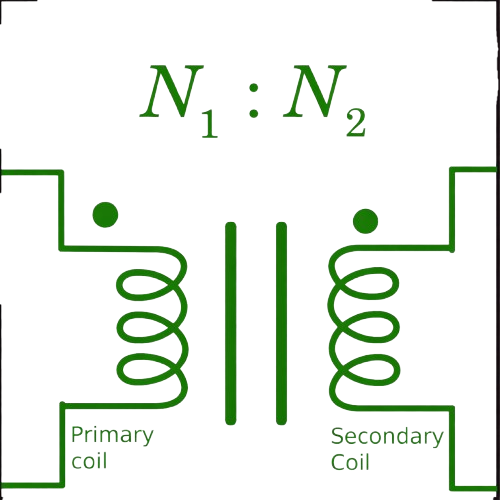
Transformer Formulas:
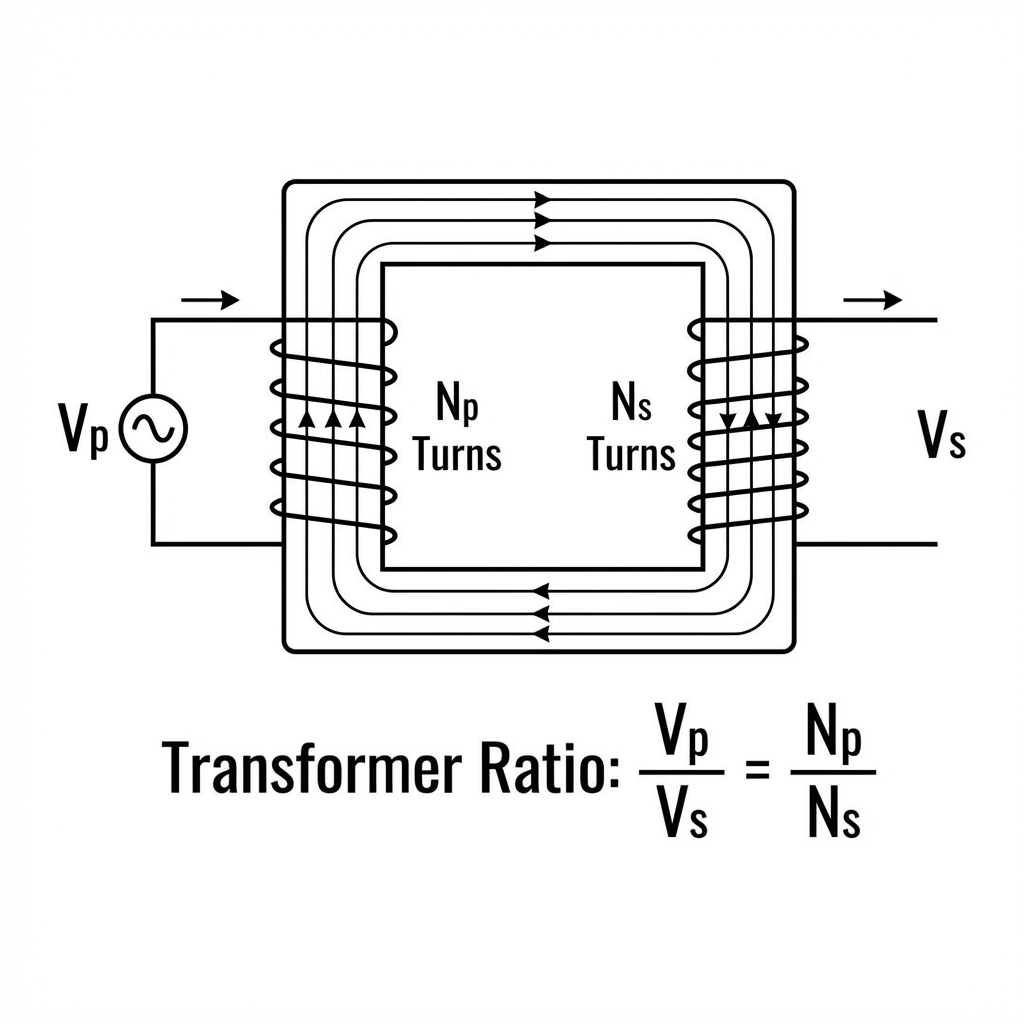
Transformer calculator considers the following equations that help you analyze a mathematical model of the transformer.
Voltage Equation:
\(V_p = N_p / N_s × V_s\)
Where:
- \(V_p\) = Primary Coil Voltage
- \(V_s\) = Secondary Coil Voltage
- \(n_p\) = Number of Turns on Primary Coil
- \(n_s\) = Number of Turns on Secondary Coil
Equivalent Current Equation:
\( I_s = I_p \cdot \frac{N_p}{N_s} \)
Load Currents:
Single-Phase:
\( \text{Full-Load Current (Amps)} = \frac{\text{kVA} \times 1000}{V} \)
Three-Phase:
\( \text{Full-Load Current (Amps)} = \frac{\text{kVA} \times 1000}{\sqrt{3} \cdot V} \)
Turns Ratio:
\( \text{Turns Ratio} = \frac{N_1}{N_2} = \frac{V_1}{V_2} = \frac{I_2}{I_1} \)
Example:
Consider a single-phase transformer of size 56 kVA. Its primary voltage is 350 V and secondary voltage is 120 V. Assuming the transformer is ideal, calculate the turns ratio and full-load currents.
Solution:
Step 1: Turns Ratio
Turns Ratio:
\( \text{Turns Ratio} = \frac{N_1}{N_2} = \frac{V_1}{V_2} = \frac{350}{120} \approx 2.917 \)
Step 2: Full-Load Currents
Primary:
\( I_\text{primary} = \frac{\text{kVA} \times 1000}{V_1} = \frac{56 \times 1000}{350} \approx 160 \text{ A} \)
Secondary:
\( I_\text{secondary} = \frac{\text{kVA} \times 1000}{V_2} = \frac{56 \times 1000}{120} \approx 466.67 \text{ A} \)
Related: Do not forget to calculate Voltage Drops and Amperage across different circuits while analyzing the functionality of a transformer.
How To Size a Transformer?
To size a transformer effectively, you can use the given equation. All you need to simply multiply the amperes with the secondary output voltage.
Mathematically:(VA) = Secondary Voltage * Required Current
Important:
We do not recommend loading a transformer above 80% of its KVA rating. To find the minimum KVA rating needed, divide the calculated KVA by a factor of 0.8. All values should be reviewed and confirmed by an electrician or electrical engineer.
People Also Ask (Transformer Queries)
Why Is Rectifier Used In Transformers?
In a transformer, a rectifier behaves as a device that converts the AC into a high DC. This direct amperage is further used for different chemical processes, including
- Chlorine production
- Copper production
- Aluminum production
What Is the Primary Difference Between kW and kVA?
Power factor is the basic difference between kW and kVA. Where the kW is the power of the real transformer, the kVA is considered the power factor of the apparent transformer.
How Many Amps Can a 150 kVA Transformer Handle?
A 150 Kva transformer can handle primary voltage up to 480 V and secondary voltage up to 120/280V. The equivalent current rating for the voltage os about 400 Amps - CU.
Transformer Amperage Chart:
Single Phase Transformers, Full Load Amperes (FLC):
| KVA | 120V | 208V | 240V | 277V | 480V | 600V |
| .25 | 1.2 | 1. | 0.9 | 0.5 | 0.4 | |
| .50 | 4.2 | 2.4 | 2.1 | 1.8 | 1.0 | 0.8 |
| .75 | 6.3 | 3.6 | 3.1 | 2.7 | 1.6 | 1.3 |
| 1 | 8.3 | 4.8 | 4.2 | 3.6 | 2.1 | 1.7 |
| 1.5 | 12.5 | 7.2 | 6.2 | 5.4 | 3.1 | 2.5 |
| 2 | 16.7 | 9.6 | 8.3 | 7.2 | 4.2 | 3.3 |
| 3 | 25 | 14.4 | 12.5 | 10.8 | 6.2 | 5 |
| 5 | 41 | 24 | 20.8 | 18 | 10.4 | 8.3 |
| 7.5 | 62 | 36 | 31 | 27 | 15.6 | 12.5 |
| 10 | 83 | 48 | 41 | 36 | 20.8 | 16.7 |
| 15 | 125 | 72 | 62 | 54 | 31 | 25 |
| 25 | 206 | 120 | 104 | 90 | 52 | 41 |
| 37.5 | 312 | 180 | 156 | 135 | 76 | 62 |
| 50 | 416 | 240 | 208 | 180 | 104 | 83 |
| 75 | 625 | 340 | 312 | 270 | 156 | 125 |
| 100 | 833 | 480 | 416 | 361 | 208 | 166 |
| 167 | 1391 | 803 | 695 | 603 | 347 | 278 |
Three Phase Transformers, Full Load Amperes (FLC):
| KVA | 208V | 240V | 480V | 600V |
| 3 | 8.3 | 7.2 | 3.6 | 2.9 |
| 6 | 16.6 | 14.4 | 7.2 | 5.8 |
| 9 | 25 | 21.6 | 10.8 | 8.6 |
| 15 | 41.7 | 36.1 | 18.0 | 14.4 |
| 30 | 83.4 | 72.3 | 36.1 | 28.9 |
| 45 | 124 | 108 | 54.2 | 43.4 |
| 75 | 208 | 180 | 90 | 72 |
| 112.5 | 312 | 270 | 135 | 108 |
| 150 | 416 | 360 | 180 | 144 |
| 225 | 624 | 541 | 270 | 216 |
| 300 | 832 | 721 | 360 | 288 |
| 500 | 1387 | 1202 | 601 | 481 |
| 750 | 2084 | 1806 | 903 | 723 |
| 1000 | 2779 | 2408 | 1204 | 963 |
Insulation Class and Temperature Rise:
| KVA | Insulation | |||
| 1 Phase | 3 Phase | NEMA Class | Temperature Class | Temperature Rise |
| 0.25-25 | 3-15 | F | 180° C | 115° C |
| 15-167 | 15-1000 | H | 220° C | 150° C |
Related Tools